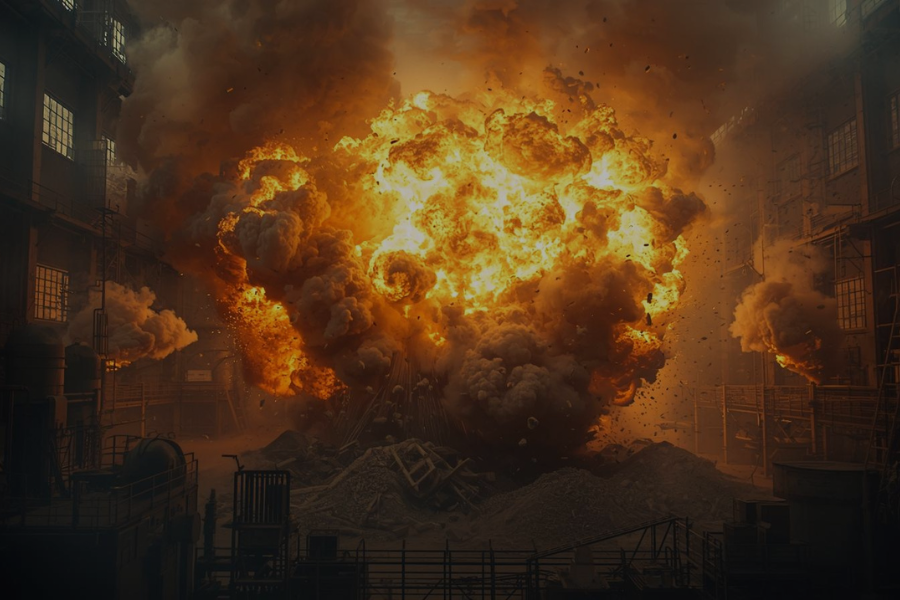
Everyday ingredients like flour, sugar, starch, milk powder and even coffee may seem harmless in a food manufacturing environment—but under the wrong conditions, these common raw materials can become fuel for a devastating dust explosion. Fine particles suspended in the air can ignite with surprising force, turning a small spark into a catastrophic event that threatens workers’ lives, damages equipment, and halts production.
Imperial Sugar Dust Explosion
For food manufacturers, the danger isn’t theoretical—it’s real; it’s preventable, and it’s often overlooked. One of the most devastating global dust explosion events occurred in 2008 at an Imperial Sugar factory in Georgia in the United States. Unfortunately, 14 people lost their lives in this tragic event. This video explains what happens and is an excellent tool for understanding the risks associated with combustible dust.
Preventing the Disaster
To manage the risk, we can break it down to focus on:
- Eliminating the dust – ensuring the dust cannot reach “explosive” concentrations, and
- Eliminating the ignition source – remove any potential source of ignition from the area where dust may be present.
I only handle small quantities, is this an issue for me?
Food industry operators who handle large quantities of grain, flour, or other fine organic materials typically understand the risk associated with combustible dust and the requirements to manage this hazard. For many that handle smaller quantities of these materials, it may not be as clear as what is required.
The process of defining the hazardous areas in your facility, otherwise known as Hazardous Area Classification (HAC), is a good way of understanding where you have exposure to your facility.
Understanding Hazardous Area Classification
HAC involves identifying zones within a facility where explosive atmospheres may occur and determining the likelihood and duration of such events. Australian Standards such as AS/NZS 60079.10.2 govern classification in dust environments. These standards align closely with international frameworks like IEC and NFPA.
Dust environments are typically classified into the following zones:
- Zone 20 – Continuous presence of combustible dust in air under normal conditions.
- Zone 21 – Likely presence of combustible dust during normal operations.
- Zone 22 – Dust may be present, but only under abnormal conditions.
Classification considers dust properties such as particle size, moisture content, minimum ignition of energy (MIE), and explosion severity.
Ignition Source Controls
- Electrical Equipment Certification: Use dust certified (Ex-rated) electrical equipment suitable for classified zones.
- Hot Work: Implement hot work permits, fire watches, and isolation procedures during welding, grinding, or cutting.
- Static Electricity Control: Apply proper bonding, grounding, and anti-static flooring to minimise static discharge.
- Mechanical Equipment Safeguards: Ensure moving parts such as bearings, conveyors, and motors are monitored to prevent overheating, friction sparks, or metal-to-metal contact.
- Surface Temperature Control: Maintain equipment surface temperatures below the minimum ignition temperature (MIT) of the dust.
Engineering Controls
- Dust Collection Systems: Installation of enclosed dust extraction units at source points.
- Explosion Venting and Suppression: Use of vents and suppression systems to safely manage overpressure.
- Sealed Transfer Systems: Minimizing open transfers of dry material.
- Inerting: Introduction of inert gases like nitrogen to prevent ignition in closed systems.
- Temperature Control: Avoiding hot surfaces in equipment to stay below the dust’s ignition temperature.
Management and Administrative Controls
- Routine Housekeeping: Scheduled cleaning to prevent dust accumulation on surfaces.
- Preventive Maintenance: Regular inspection of equipment to detect and repair leaks, corrosion, and overheating.
- Hazardous Area Inspections: Ensuring compliance with area zoning and equipment certifications.
- Training and Awareness: Staff should understand the risks, zoning implications, and appropriate behaviours.
How @Risk Underwriting Can Help
Hazardous Area Classification is a process in maintaining operational safety in dust-prone environments. Understanding how dust behaves, where it accumulates, and how it may ignite is central to mitigating explosion risks. Integrating traditional controls with digital tools strengthens proactive hazard management, enhances compliance with Australian standards, and most importantly, protects people, property, and production continuity.
@Risk Underwriting supports the clients by:
- Identifying dust hazards and ignition sources
- Implementing effective safety controls
- Ensuring regulatory compliance
- Protecting people, assets, and production
Our experts provide practical strategies for facilities of all sizes, helping you manage risk proactively and keep operations safe.
For more information and enquiries, please contact us.
Recent Comments