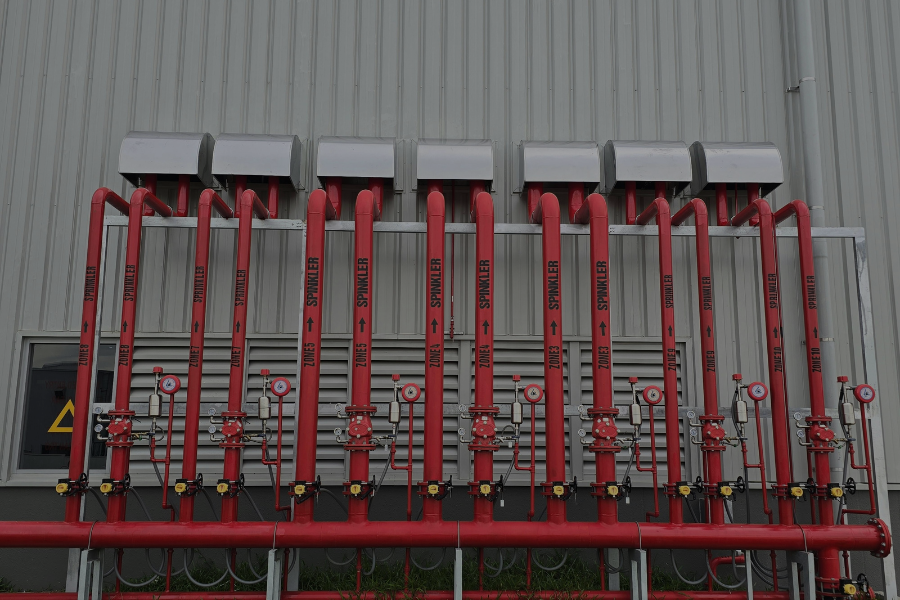
Every broker knows how important the fire systems for their client are. You walk through your client’s premises and you see fire extinguishers, shiny red hydrants, fire hose reels, all looks pretty good right? In reality we rely on the risk engineer’s inspection to give you the feedback that underwriters are looking for. But what if I could tell you the one piece of paper to look for to give you a good idea of whether all the fire systems are up to scratch?
Every year, building owners and facility managers across Australia go through the same ritual: fire safety equipment gets inspected, a compliance certificate gets filed away, and life moves on. It’s easy to treat this as a box-ticking exercise. It shouldn’t be — because that piece of paper is one of the most important documents to understand how well your fire systems are maintained.
What Are We Actually Talking About?
Every state and territory places some form of ongoing maintenance obligation on building owners for essential fire safety measures — things like sprinklers, fire doors, smoke alarms, emergency lighting, and fire hydrants. In most jurisdictions this extends to a formal annual statement or certificate lodged with a regulator; a few, such as the Northern Territory, rely more on an ongoing maintenance obligation without a standardised annual lodgement. A summary of the obligations in each jurisdiction is included in the table below:
| Jurisdiction | Annual Compliance Certificate | Building Regulation | What’s actually required? |
| New South Wales | Annual Fire Safety Statement (AFSS) | Environmental Planning and Assessment Regulations 2000 | Owners must engage a competent fire safety practitioner to assess each fire safety measure against the standard listed on the property’s fire safety schedule. |
| Victoria | Annual Essential Safety Measures Report (AESMR) | Building Regulation 2018 | Prepared under Building Regulations 2018, certifying that each essential safety measure listed for the building continues to perform to the required standard. |
| Queensland | Occupier’s Statement | Building Fire Safety Regulations 2008 (July 2017) | Confirming maintenance of fire safety installations under the Building Fire Safety Regulation 2008 and the Queensland Development Code and lodged with Queensland Fire and Emergency Services. |
| South Australia | Annual Certificate of Compliance (Form 3, Schedule 16) | Development Regulations 2008 | Confirming that Essential Safety Provisions (ESPs) listed on the building’s schedule have been inspected, tested, and maintained, under the Planning, Development and Infrastructure Act 2016 and associated General Regulations. |
| Western Australia | N/A | Building Regulation 2012 | No Annual Essential Service Statement is submitted to a regulator, but owners must ensure all safety measures are maintained and serviced to current regulations, the National Construction Code, and applicable Australian Standards. An Annual Compliance Report can still be issued to evidence this. |
| Tasmania | N/A | Building Regulation 2016 | Owners must set up and maintain a maintenance schedule for prescribed essential building services. Maintenance records must be kept for a minimum of 10 years and made available to authorities on request. |
| ACT | N/A | ACT Fire Brigade Policy | No annual statement is required, but ACT Fire & Rescue’s Fire Safety Guideline sets out maintenance obligations aligned with AS 1851, including a duty to notify ACT Fire & Rescue directly of critical defects. |
| Northern Territory | N/A | Fire and Emergency Regulations | Maintenance of safety installations is the building owner’s responsibility under the NT variation of the National Construction Code. An Annual Compliance Report can be issued to evidence ongoing compliance. |
If your clients have operations across multiple states, this is not a “set and forget” compliance task — it’s a jurisdiction-by-jurisdiction obligation that needs to be tracked separately for each property.
Why This Matters for Your Clients
Whilst many see this as just another compliance task to be ticked off every year, from a risk management perspective, this is where things get serious. An expired, incomplete, missing, or inaccurate fire safety statement doesn’t just expose you to a fine from your local council or fire authority — it can directly undermine your insurance cover in several ways:
- Incomplete Statement generally means there are issues with the fire systemjs that need attention and that the systems are not currently fit for purpose.
- Duty of disclosure – If there are issues with the fire systems has this been disclosed? If that turns out not to be true at the time of a loss, insurers can treat this as non-disclosure — potentially voiding cover, even if the fire had nothing to do with the specific measure that lapsed.
- Breach of policy conditions – Many commercial property policies require fire protection equipment to be kept in good working order and compliant with statutory obligations. A lapsed statement is often the clearest evidence that this condition wasn’t met, giving insurers grounds to dispute a claim.
- Evidence in the claim’s investigation – After a fire loss, loss adjusters routinely request compliance records. A current, accurate statement strengthens your position; a gap in the paper trail invites scrutiny and can slow or complicate settlement.
- Underwriting and premium impact – A history of lapsed statements or unresolved defects can affect how underwriters view the insured’s risk profile — influencing terms, premiums, or willingness to offer cover at renewal.
What Good Practice Looks Like
Any organisation that takes a proactive approach to risk management should see these annual statements as critical governance documentation. It is the one record that should give your client’s comfort that their maintenance providers are keeping your fire systems in appropriate working order. If you’re asking about it, it shows you have an understanding of fire systems and are really adding value to the process. You’re not a fire engineer, but it is simple enough to see that the statement is available and current… or not.
We recommend clients treat fire safety certification as an active risk management process rather than an annual paperwork exercise:
- Maintain a compliance calendar tracking due dates for every property, by state.
- Engage appropriately accredited practitioners — requirements for who can certify differ by jurisdiction.
- Address defects promptly rather than noting them and moving on; an unresolved defect on a statement can itself become a disclosure issue.
- Keep historical records accessible, not just the current statement — insurers and investigators often want to see the trend, not just a snapshot.
- Loop in your risk adviser/consultant whenever a statement identifies non-compliance, so any insurance implications can be managed proactively rather than discovered after a loss.
Conclusion
An Annual Fire Safety Statement — whatever it’s called in your state — is not just a regulatory formality. It’s a key piece of evidence that your clients can use to manage fire risk effectively and responsibly. Treating it as a genuine risk and governance control, rather than an administrative afterthought, is one of the simplest and most effective things you can do to support your client’s risk management efforts.
For questions about fire safety compliance at a specific property, or how it might affect your current policy. Please contact us — we’re happy to help.